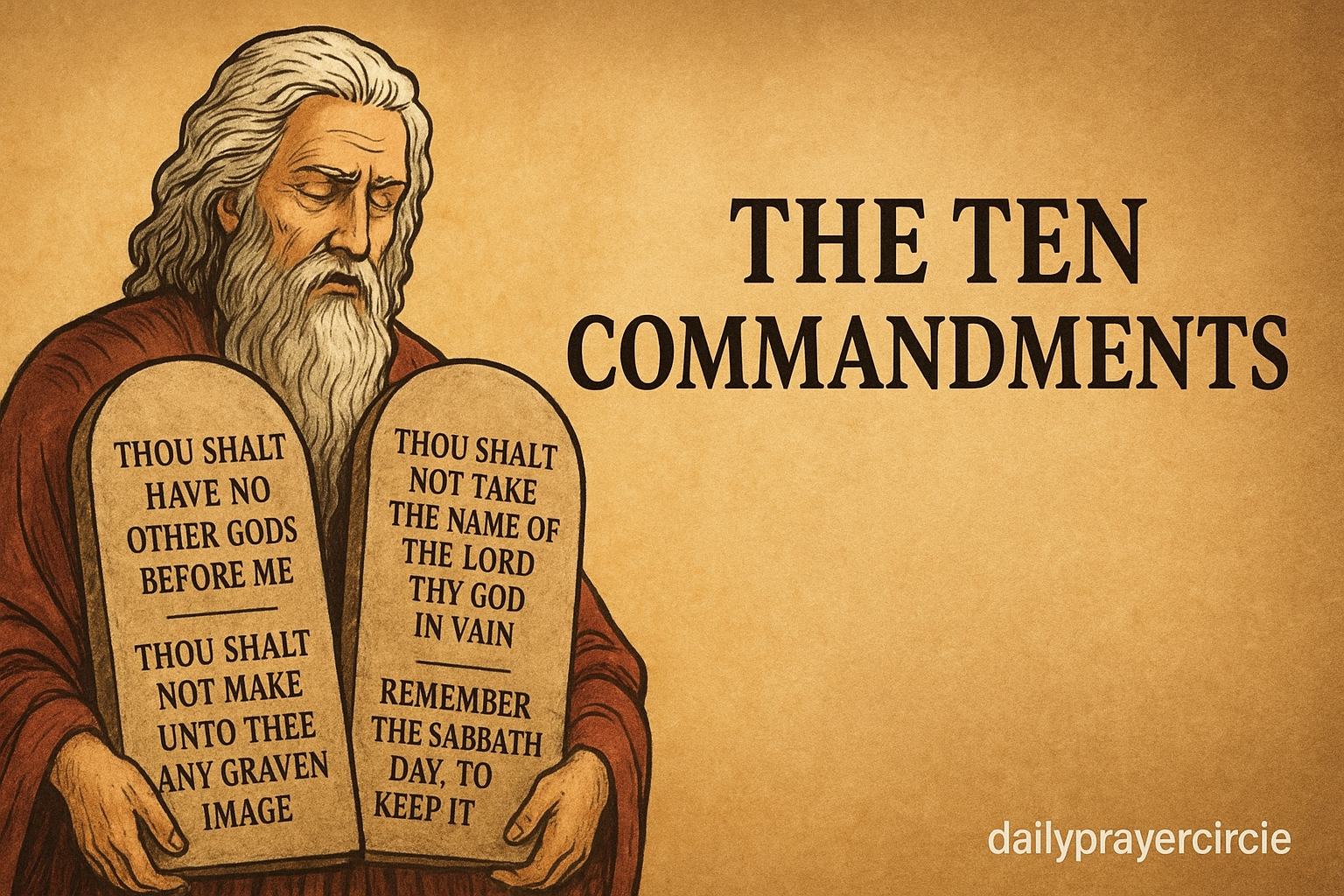
The word of God gives us a path that leads our feet away from confusion and brings them into a place of peace, order, and reverence. Many people move through life searching for direction, longing to know what pleases God, desiring a steady voice that does not change with time, culture, or human opinion. In Scripture, God did not leave His children without light. He revealed His heart in words that carry both authority and tenderness. He spoke instructions that were not meant to burden, but to guide, protect, and shape us into people who reflect His goodness in the world.
These holy commands show us how to treat God, how to treat others, and how to keep our hearts clean from things that pull us away from His truth. They are not dry teachings; they are living words. When we sit with them, pray through them, and let them sink deep into our spirit, they work like a mirror showing us where we stand and where we need God’s help. They also work like a lamp, giving us clarity in moments of confusion. These instructions reveal the seriousness of sin, the beauty of obedience, and the high value God places on love, honor, and righteousness.
From generation to generation, believers have returned to these divine principles to steady their homes, guide their actions, guard their thoughts, and align their choices with God’s will. Today, as we revisit them prayerfully, may our hearts soften, our understanding deepen, and our desire to walk humbly with God grow stronger.
The Ten Commandments-Exodus 20
1. NO OTHER GODS BEFORE HIM
Lord, You alone are worthy of my worship. Remove every false trust, every prideful thought, and every distraction that fights for the first place in my heart. Teach me to love You with all my being. Let nothing rise above You in my life. Amen.
“Thou shalt have no other gods before me.”
— Exodus 20:3 (KJV)
This first instruction calls us to place God above everyone and everything. It is easy to let ambitions, people, comfort, or even fear take the highest seat in our hearts. When God is not first, everything else becomes unstable. But when He is first, our lives gain balance and peace. Putting Him first is not just saying He matters—it is choosing Him in our actions, desires, and decisions. It is allowing His voice to guide us more than the voices around us. When He is our priority, everything else falls into its rightful place.
2. NO IDOLS
Father, cleanse me of anything I have lifted too high. Break the quiet idols that hide in my thoughts, my habits, or my desires. Let my heart bow only to You. Amen.
“Thou shalt not make unto thee any graven image…”
Idols are not only carved images; they are anything we trust more than God. They are the things we reach for first when we are afraid, angry, or lonely. Idols demand our time, our energy, and our devotion. God calls us away from these false sources of strength so we can experience true worship. Surrendering idols brings freedom. It clears our vision. It helps us recognize that only God can fill the emptiness that idols pretend to satisfy.
3. HONOR HIS NAME
Lord, help me treat Your name with holy respect. Let my words honor You. Let my speech reflect Your character. Purify my tongue and guard my heart. Amen.
“Thou shalt not take the name of the Lord thy God in vain.”
— Exodus 20:7 (KJV)
4. KEEP THE HOLY DAY
Lord, teach me to rest in You. Quiet my mind from rushing. Help me honor this sacred rhythm You created for my renewal. Amen.
“Remember the sabbath day, to keep it holy.”
— Exodus 20:8 (KJV)
In a noisy world, God gave us a day to breathe, reflect, and reconnect with Him. This instruction reminds us that rest is not laziness; it is obedience. It restores our faith, strengthens our spirit, and softens our hearts. When we pause intentionally, we give God space to refresh us. The holy day is a gift, a reset, a reminder that life is more than work—it is worship.
5. HONOR YOUR PARENTS
Heavenly Father, help me show respect, patience, and love to those who raised me. Heal any pain, soften any hardness, and let my response bring You glory. Amen.
“Honour thy father and thy mother…”
Honor is not always about agreeing but acknowledging the role God allowed them to play in our lives. Even when relationships are difficult, God calls us to practice respect. Honor brings blessings, maturity, and growth. It teaches humility and strengthens families. When we honor our parents, we recognize the value of life and the grace of God’s order.
6. DO NOT KILL
Lord, guard my heart from anger, bitterness, and hatred. Let peace guide my actions. Make me a vessel of life, not destruction. Amen.
“Thou shalt not kill.”
— Exodus 20:13 (KJV)
This instruction goes beyond physical violence. It touches the heart—where anger, envy, and hate begin. God calls us to be people who protect life, speak life, and value life. When our hearts are ruled by love, we cannot harm those God created. Walking in peace honors God and reflects His character.
7. DO NOT COMMIT ADULTERY
Lord, purify my thoughts and strengthen my commitments. Help me honor relationships with loyalty, truth, and purity. Amen.
“Thou shalt not commit adultery.”
— Exodus 20:14 (KJV)
Faithfulness is the backbone of love. When trust is broken, hearts suffer deeply. God calls us to honor the sacred bond of marriage and to respect the relationships of others. Purity is not old-fashioned; it is holy. It protects homes, futures, and souls. True love is loyal, enduring, and anchored in God.
8. DO NOT STEAL
Father, keep my heart free from greed. Teach me to be content and honest. Let my hands be clean and my intentions pure. Amen.
“Thou shalt not steal.”
— Exodus 20:15 (KJV)
9. DO NOT BEAR FALSE WITNESS
Lord, guard my tongue from lies, exaggerations, and harmful words. Help me speak truth with humility. Amen.
“Thou shalt not bear false witness against thy neighbour.”
Words have weight. Lies wound, divide, and destroy. God calls His people to be truthful—not just in major matters but in daily conversation. When we speak truth, we reflect His nature. When we refuse to gossip or misrepresent others, we build trust. Truthfulness keeps our spirit clean and honors God.
10. DO NOT COVET
Father, deliver me from envy. Teach me to celebrate others, to be grateful for my blessings, and to trust Your timing for my life. Amen.
“Thou shalt not covet…”
— Exodus 20:17 (KJV)
Coveting is a quiet sin that hides in comparison. It steals joy and blinds us to our blessings. God calls us to contentment. When we choose gratitude, our hearts become lighter. When we rejoice with others, our spirit grows. Coveting fades when we trust that God’s plan for us is good, intentional, and perfectly timed.
- Prayer for Repentance: A Powerful Path to Forgiveness, Healing, and a New Beginning with God
- Prayer for Forgiveness of Sins Renewal and Repentance
- 40 Amazing Bible Verses About Anger And
- 105+ Amazing New Week Prayer Message
- Repentance Prayer
- 40 Amazing Bible Verses About Praying In The Spirit
WHERE ARE THEY FOUND IN THE KJV?
Beloved, when we ask,
“Where are the Ten Commandments found in the KJV?”
we are not merely seeking the address of ancient laws.
We are seeking the very heartbeat of God’s covenant with His people.
We are searching for the words that shaped nations, guided morality, convicted hearts, and built the foundation for every righteous life.
The Ten Commandments are not merely written on tablets of stone—
they are written on the tablets of God’s holiness.
They are preserved in Scripture not just as rules,
but as revelations of who God is
and who we must become.
I. THE COMMANDMENTS ARE FOUND IN TWO HOLY PLACES IN THE KJV
The Ten Commandments appear twice, each time revealing a new layer of God’s heart.
1. EXODUS 20:1–17 — THE FIRST DECLARATION
This is where God Himself speaks the commandments for the first time from the mountain ablaze with fire, smoke, and thunder.
Here, the commandments appear in their raw, original, divine form.
This is the moment when:
- God’s voice shook the earth
- the mountain trembled
- the people stood in awe
- heaven touched humanity
In Exodus, the commandments are given as the divine law of a newly redeemed people—freed from Egypt, called into covenant.
2. DEUTERONOMY 5:6–21 — THE COVENANT RENEWED
Forty years later, Moses speaks the commandments again.
Not from the fire of Sinai,
but from the tenderness of a shepherd’s heart
reminding a new generation of the ancient covenant.
This second recording is not a new law—
it is a renewed reminder.
It is the voice of a father saying:
“Do not forget who you are. Do not forget who your God is.”
Thus, the Ten Commandments stand in Scripture not once, but twice—
first as revelation,
then as reaffirmation.
II. WHY THEY ARE FOUND THERE: A MESSAGE FOR ALL GENERATIONS
Beloved, the placement of the commandments in Scripture is not accidental.
Exodus and Deuteronomy form the backbone of Israel’s identity.
And their presence in both books teaches us:
1. What God speaks once, He establishes twice.
In Scripture, repetition is permanence.
Repetition is covenant.
Repetition is divine emphasis.
2. God speaks commands in power—but reinforces them in love.
At Sinai: thunder, fire, trumpet, glory.
In Deuteronomy: tenderness, memory, fatherly teaching.
The commandments come both with authority and with affection.
III. THE COMMANDMENTS REVEAL GOD’S CHARACTER
Where they are found in the KJV tells us much about why they matter.
In Exodus, they follow the story of deliverance.
In Deuteronomy, they precede the story of inheritance.
Deliverance → Commandments → Inheritance
Why?
Because God saves us before He commands us.
And He commands us before He blesses us.
He does not give rules to enslaved people,
but to free people
on their way to promise.
Thus the commandments are not burdens;
they are blessings.
They are:
- protection
- boundaries of love
- mirrors of holiness
- guides for righteous living
IV. THE COMMANDMENTS DRAW A LINE BETWEEN HOLINESS AND WORLDLINESS
In both Exodus and Deuteronomy, God shows us that holiness is not random.
It is deliberate.
It is disciplined.
It is defined.
The Ten Commandments form the foundation from which all later laws and teachings flow.
Jesus Himself affirms their spirit when He says:
“If ye love me, keep my commandments.” (John 14:15)
He did not erase what God spoke from Sinai—
He fulfilled it, deepened it, and revealed its true spiritual meaning.
V. IN SUMMARY: WHERE ARE THEY FOUND IN THE KJV?
The Ten Commandments appear in Scripture twice, once from the mountain, once from Moses’ heart:
• Exodus 20:1–17 — The original giving of the law
• Deuteronomy 5:6–21 — The renewed covenant reminder
These two passages form the pillars of divine morality,
standing unshaken through generations and civilizations.
VI. A FINISHING WORD
So, beloved, when you ask,
“Where are they found in the KJV?”
you are asking more than a geographical question.
You are seeking the blueprints of God’s moral universe.
And the Lord answers:
They are found where I revealed My holiness (Exodus 20).
They are found where I renewed My covenant (Deuteronomy 5).
They are found where My voice shaped a nation.
They are found where My love shaped a people.
They are found where My truth stands eternal.
May the commandments not only be found in Scripture,
but found in our hearts,
found in our actions,
found in our homes,
and found in our daily walk with God.
Amen.
WHAT ARE THE 10 SINS IN THE BIBLE?
These are not labeled “ten sins” in Scripture, but they correspond to the violations of each holy instruction:
- Placing anything above God
- Making idols
- Misusing His name
- Dishonoring the holy day
- Dishonoring parents
- Murder
- Adultery
- Stealing
- Lying or false witness
- Coveting
Each one reveals how sin begins in the heart and moves into actions.
Beloved, when we ask,
“What are the 10 sins in the Bible?”
we are not simply asking for a list of wrongdoings.
We are seeking the spiritual boundaries that God Himself has drawn—
boundaries that protect the soul,
preserve holiness,
and guard us from the destruction that sin brings.
The Bible is not silent about sin.
It speaks with the authority of heaven,
the wisdom of eternity,
and the compassion of a God who desires that none should perish.
And so, to understand 10 major sins highlighted in Scripture, we must see them not as human classifications,
but as spiritual dangers God warns us about.
Here are 10 significant sins repeatedly condemned throughout the Bible,
each representing a category of disobedience that destroys the heart and separates the soul from God.
THE 10 SINS OF THE BIBLE — A SPIRITUAL OVERVIEW
1. Idolatry
The worship of anything other than God.
It is the sin of giving the heart to what cannot save.
Israel’s greatest downfall throughout Scripture was not war or enemies—
it was idolatry.
“Thou shalt have no other gods before me.” (Exodus 20:3)
Idolatry today may not be carved images—
it may be money, relationships, pride, or self.
2. Murder and Violence
From Cain to the Cross, God condemns the taking of innocent life.
“Thou shalt not kill.” (Exodus 20:13)
Violence begins in the heart long before it reaches the hands.
Jesus teaches that hatred itself is the seed of murder.
3. Adultery and Sexual Immorality
Scripture calls the body a temple—
and warns that defiling it destroys the soul.
“Thou shalt not commit adultery.” (Exodus 20:14)
Every betrayal wounds not just relationships,
but covenant itself.
4. Stealing
When God forbids stealing,
He is defending trust, honesty, and the dignity of human labor.
“Thou shalt not steal.” (Exodus 20:15)
Theft is more than taking—it is a violation of God’s order.
5. Bearing False Witness (Lying)
Lies fracture families, destroy reputations, and poison communities.
“Thou shalt not bear false witness.” (Exodus 20:16)
A lie may seem small,
but in the spiritual realm, it is an act of destruction.
6. Covetousness
The silent sin of comparison, jealousy, and desire for what is not yours.
“Thou shalt not covet.” (Exodus 20:17)
Covetousness is dangerous because it hides in the heart
and births every other sin.
7. Pride
The first sin in heaven.
The fall of Lucifer began with the elevation of self.
“Pride goeth before destruction.” (Proverbs 16:18)
All sin grows from the soil of pride.
8. Blasphemy
To treat God’s holy name, character, or works with contempt.
“Thou shalt not take the name of the Lord thy God in vain.” (Exodus 20:7)
Blasphemy is not merely a word—
it is the sin of dishonoring God Himself.
9. Dishonoring Parents and Authority
God connects family respect to societal stability.
“Honour thy father and thy mother.” (Exodus 20:12)
Where honor disappears,
rebellion grows.
And where rebellion grows,
chaos follows.
10. Unbelief / Rejection of God
The root of all spiritual decay is refusing the God who created and redeemed us.
“Without faith it is impossible to please him.” (Hebrews 11:6)
Unbelief is not merely doubt—
it is the sin of closing the heart
to the one who offers salvation.
WHY THESE 10 SINS MATTER
Beloved, these sins do not merely break rules—
they break relationship.
They fracture the bond between humanity and the God who loves us.
The question “What are the 10 sins?”
is not a historical inquiry—
it is a spiritual alarm.
It calls us back to holiness,
back to repentance,
back to the path where grace flows freely.
For sin destroys,
but grace restores.
Sin separates,
but Christ reconciles.
Sin wounds,
but the blood of Jesus heals all who come to Him.
So when you ask,
“What are the 10 sins in the Bible?”
remember:
God does not reveal sin to shame us
but to save us.
He exposes darkness
so He can bring us into light.
He names sin
so He can remove its chains.
He warns us
because He loves us.
May we walk in the holiness that pleases God,
reject the sins that destroy the soul,
and embrace the mercy that leads to everlasting life.
Amen.
WHAT IS THE #1 WORST SIN?
Scripture shows that the deepest sin is turning away from God Himself—rejecting Him, refusing Him, denying Him, and placing anything above Him. It is the root from which all other disobedience grows. When the heart abandons God, every other sin becomes easier. When the heart returns to Him, healing begins.
Beloved, throughout every generation believers have whispered the same question:
“Lord, what sin hurts You the most? What is the worst sin in the Bible?”
It is a question born from the desire to walk rightly with God, to avoid the path that leads away from His presence, and to understand what truly breaks His heart.
And though Scripture names many sins—lying, adultery, idolatry, murder—Jesus Himself leads us to a deeper truth. The worst sin is not merely an action of the hands but a rebellion of the heart. It is not simply something we do, but something we become when we separate ourselves from the very God who made us.
Let us walk together through the Word to find this answer.
THE #1 WORST SIN: REJECTING GOD — THE SIN OF UNBELIEF
According to Scripture, the greatest and most devastating sin is rejecting God Himself—the sin of unbelief that refuses the truth, resists the Spirit, and hardens the heart against the Lord.
Jesus declares this with holy clarity:
John 16:8–9 (KJV)
“And when he is come, he will reprove the world of sin…
Of sin, because they believe not on me.”
Christ Himself identifies the core sin as unbelief—the heart that rejects the Savior.
This is why unbelief is the root from which all other sins grow.
It is the fountainhead of rebellion, the soil in which evil roots itself, the doorway through which darkness enters the soul.
1. UNBELIEF IS THE SIN THAT MAKES ALL OTHER SINS POSSIBLE
Before Adam and Eve ever committed an outward act, their hearts doubted God’s word.
They first believed the serpent more than the Savior.
They distrusted the voice of the One who formed them.
Thus, the first sin was not eating the fruit.
The first sin was unbelief.
Romans 14:23 (KJV)
“For whatsoever is not of faith is sin.”
Every sin begins where faith dies.
2. UNBELIEF REJECTS THE VERY CHARACTER OF GOD
Unbelief says:
- “God is not who He says He is.”
- “His promises are not true.”
- “His commandments are not good.”
- “His presence is not enough.”
It is an assault on God’s goodness, His faithfulness, His holiness, and His love.
Hebrews 3:12 (KJV)
“Take heed… lest there be in any of you an evil heart of unbelief, in departing from the living God.”
Notice Scripture calls it:
an evil heart — not an evil action.
Why?
Because unbelief strikes at the very center of who God is and who we are in Him.
3. UNBELIEF REJECTS THE ONLY DOOR TO SALVATION
All sins can be forgiven, but there is one sin that shuts the door of grace:
refusing the grace itself.
This is why Jesus described the sin of rejecting the Holy Spirit—resisting His call, His conviction, His invitation to repent—as the one sin that leads to eternal separation.
Mark 3:28–29 (KJV)
“All sins shall be forgiven…
But he that shall blaspheme against the Holy Ghost hath never forgiveness…”
The Holy Spirit’s ministry is to draw the sinner to Christ.
Rejecting Him is rejecting the Savior.
Rejecting the Savior is rejecting salvation.
Thus the worst sin is the sin that keeps a person from forgiveness.
4. UNBELIEF IS THE ONLY SIN THAT FOLLOWS A PERSON INTO ETERNITY
Every sin—no matter how dark—can be washed by the blood of Jesus.
The thief on the cross was forgiven.
David was forgiven.
Saul of Tarsus was forgiven.
But there is one thing even the blood cannot cleanse:
The heart that refuses to come to the blood.
John 3:18 (KJV)
“…he that believeth not is condemned already…”
Why?
Not because God rejected him—
but because he rejected the only path to mercy.
5. UNBELIEF INSULTS THE SACRIFICE OF CHRIST
When someone rejects God’s offer of salvation, they are not merely declining an invitation.
They are despising a sacrifice.
Hebrews 10:29 (KJV)
“Of how much sorer punishment… shall he be thought worthy, who hath trodden under foot the Son of God…”
Unbelief looks at the cross and says,
“I don’t need it.”
“What He did is not enough.”
“I can live without Him.”
This is why unbelief is the greatest tragedy of the human soul.
6. UNBELIEF DOES NOT STAY SILENT — IT PRODUCES ALL OTHER SINS
Where unbelief lives:
- Pride rises
- Idolatry forms
- Disobedience grows
- Sin multiplies
Unbelief is the seed; all other sins are the fruit.
The worst sin, therefore, is the rebellion that rejects the Source of life, the Giver of grace, and the Savior of the world.
THE PATH BACK TO LIFE
Beloved, the worst sin is not the one you fear you have committed.
The worst sin is the one that keeps a person away from the One who forgives sins.
Hear the gentle voice of Jesus today:
John 6:37 (KJV)
“Him that cometh to me I will in no wise cast out.”
If you come, He will receive you.
If you ask, He will forgive you.
If you believe, He will restore you.
The worst sin is unbelief.
But the greatest act of the human heart is faith.
May we choose faith.
May we choose Christ.
May we choose life.
Amen.
CONCLUSION
As we reflect on these holy instructions, we see not only commands but invitations—calls to live differently, to stand apart, to honor God with our lives. They remind us that God desires our hearts, not just our actions. They show us where we must surrender, where we must grow, where we must repent, and where we must lean on His grace. No one keeps these commands perfectly on their own. We need God’s help, His mercy, and His Spirit to walk in obedience.
These teachings pull us back to the heart of worship. They teach us honor, purity, gratitude, truth, faithfulness, rest, and reverence. They build our character and strengthen our walk with God. They shape our home, our relationships, and our understanding of holiness.
May these words remain alive within us. May they guide our choices, soften our hearts, and turn our eyes back to God. And may our lives reflect the One who calls us into righteousness, not through fear, but through love, grace, and truth. Amen.